
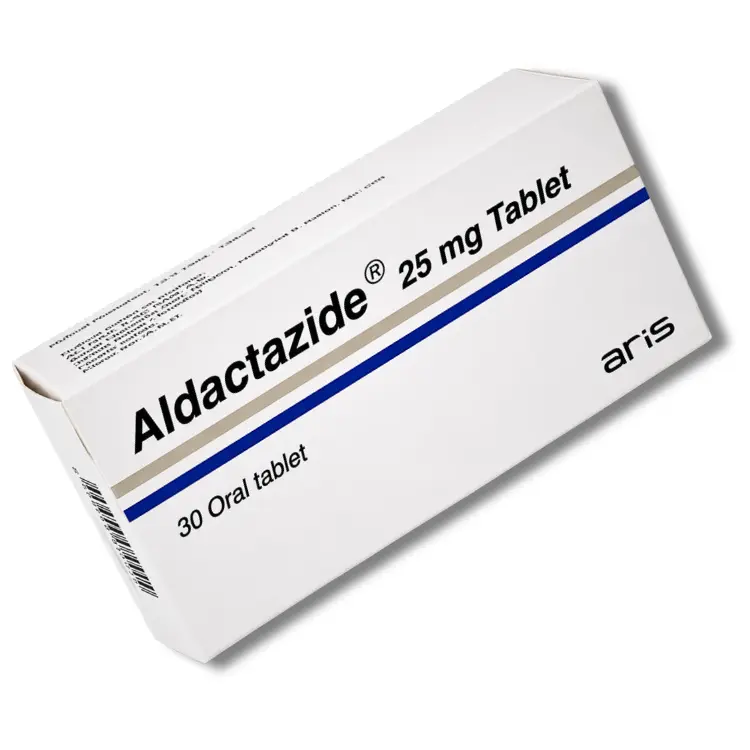
What is Aldactazide?
Aldactazide combines spironolactone, a potassium-sparing aldosterone antagonist, with hydrochlorothiazide (HCTZ), a thiazide diuretic. It is used for fluid retention in heart failure, cirrhosis or nephrotic syndrome when other measures are not enough, for essential hypertension, and to correct low potassium caused by diuretics. Its labelling opens with a caution: spironolactone was tumour-forming in chronic rat studies, so the combination should be used only for its listed conditions and unnecessary use avoided.1
Approved products and generic therapeutic-equivalence ratings are listed in the FDA Orange Book.3
The two diuretics act at different parts of the kidney tubule. HCTZ increases sodium and chloride loss but also drives potassium out, while spironolactone blocks aldosterone and conserves potassium, so in most people the combination limits the potassium loss caused by HCTZ alone.1
Because of the prolonged action of spironolactone, the diuretic effect starts promptly and persists for two to three days after the tablets are stopped.
In cirrhosis with fluid or ascites, aldosterone levels may be exceptionally high, which is one reason an aldosterone blocker is part of maintenance treatment there.
The labelling advises establishing the dose by titrating the two components separately; separate tablets of either drug may be added when needed.
The current tablets are round, tan and film-coated, each containing equal amounts of the two drugs.
Single-ingredient spironolactone is described on the Aldactone page; both belong to the blood pressure medicines.