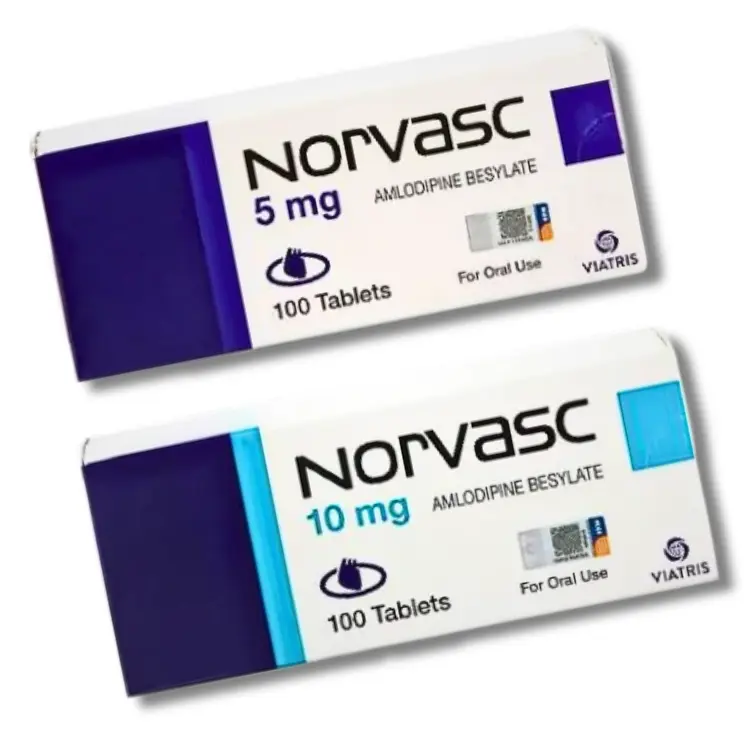
Norvasc: Uses, Dosage & Safety Information

Norvasc

Norvasc

Norvasc

Amlodipine
Original brand of a slow-onset calcium antagonist, cleared in 1992, used for raised readings from age six, chest pain and proven coronary narrowing. A large trial showed fewer angina admissions and procedures, it does not treat heart failure, and liquid versions now exist.
  • ActiveIngredient: Amlodipine
  • DosageForm: Tablet
  • Dosage: 2.5 mg, 5 mg, 10 mg
  • Indications: Hypertension, chronic stable angina, vasospastic angina, coronary artery disease
  • Manufacturer: Viatris
  • Storage: 20–25°C (68–77°F)
  • Drug Status: Prescription Only

What is Norvasc?

Norvasc is the original brand of amlodipine besylate, a long-acting calcium channel blocker approved for high blood pressure and for coronary artery disease, including chronic stable and vasospastic angina. It is still marketed by Viatris. In the CAMELOT trial, adding Norvasc to standard care in people with coronary disease reduced major cardiovascular events, mainly angina admissions and procedures. In people with severe heart failure it neither helped nor worsened survival, although fluid on the lungs was reported more often.1

FDA-approved brand, prescription only
Norvasc tablets (NDA 019787) were approved in July 1992 and remain a prescription brand; amlodipine is also approved as an oral suspension, Katerzia (2019), and an oral solution, Norliqva (2022).2

Approved products and generic therapeutic-equivalence ratings are listed in the FDA Orange Book.3

Because its blood-pressure-lowering action develops gradually, sudden low blood pressure after a dose is unlikely, although symptomatic hypotension can occur, particularly with severe aortic stenosis.1

Starting doses are lower for people who are small, frail or elderly and for those with liver impairment, and dose steps are usually spaced 7 to 14 days apart.

Amlodipine is broken down by the liver enzyme CYP3A, so moderate or strong inhibitors raise its levels; it in turn raises exposure to simvastatin, cyclosporine and tacrolimus.

Side effects other than ankle swelling, such as fatigue, nausea, abdominal pain and sleepiness, were not related to dose.

Norvasc belongs to the blood pressure medicines; generic amlodipine besylate contains the same active ingredient, and Lotrel combines it with benazepril.

How to Take Norvasc

Once a day, food optional

Take Norvasc once a day at about the same time; food does not change how much is absorbed, so it can be taken with or without meals.1

Dose steps take time

Your prescriber usually waits 7 to 14 days between dose changes to see the full effect of each step.

Chest pain after starting

Report new or worsening chest pain after starting Norvasc or increasing the dose, especially if you have severe coronary disease.

Liquid forms

If swallowing tablets is difficult, ask whether an amlodipine oral suspension or solution is suitable for you.2

Medicines to mention

Tell your doctor if you take simvastatin, cyclosporine, tacrolimus or sildenafil, which interact with amlodipine.1

Ankle swelling

Ankle swelling is more common at the higher dose and in women; mention it to your doctor rather than stopping on your own.

Children

In children aged 6 to 17, low doses are used; doses above the lower range have not been studied in children.

What Are the Side Effects of Norvasc?

Ankle swelling was the main dose-related reaction; dizziness, flushing and palpitations also rose at the higher dose, while fatigue, nausea, abdominal pain and sleepiness were not dose-related.

Norvasc: Dose-Related Reactions
FrequencyEffectNotes
Common — 3.4% at 5 or 10 mg (placebo 1.5%)DizzinessPlacebo-controlled trials
Common — 2.6% at 10 mg (placebo 0%)FlushingDose-related
Common — 4.5% at 10 mg (placebo 0.6%)PalpitationsDose-related
Common — 4.5% (placebo 2.8%)FatigueNot dose-related
Common — 2.9% (placebo 1.9%)NauseaNot dose-related
Frequency not established (labelled)Worsening angina or heart attack on starting, especially in severe coronary diseaseWarnings

Source: 1

Seek immediate medical attention if:
  • New or worsening chest pain
  • Fainting or severe dizziness
  • Breathlessness with rapid weight gain
  • Yellowing of the skin or eyes
Clinical details

Flushing and palpitations were more common in women than in men: flushing 4.5% versus 1.5%, and palpitations 3.3% versus 1.4%.

What is Norvasc Used For?

Norvasc is indicated for high blood pressure (also shown effective in children aged 6 to 17), alone or with other blood pressure and angina drugs, and for coronary artery disease: chronic stable angina, vasospastic angina, and angiographically documented coronary disease without heart failure or an ejection fraction below 40%, to reduce angina admissions and revascularisation.1

Coronary disease (CAMELOT)

CAMELOT randomised 1,318 people with recently documented coronary disease, most already on aspirin, statins and beta-blockers, to Norvasc or placebo for a mean of 19 months. First major cardiovascular events occurred in 16.6% on Norvasc versus 23.1% on placebo (hazard ratio 0.69), driven largely by fewer angina admissions and revascularisation procedures.1

Vasospastic angina

In a four-week trial in 50 patients, Norvasc reduced attacks by about four a week, compared with about one a week on placebo; 2 of 23 Norvasc and 7 of 27 placebo patients withdrew for lack of improvement.1

Heart failure

In a 1,153-patient study of severe heart failure, combined deaths and cardiac events were 39% on Norvasc and 42% on placebo, and PRAISE-2 found no significant difference in mortality; more reports of fluid on the lungs occurred with Norvasc, so it is not a heart-failure treatment.1

Interactions Alcohol:

Consult your doctor
Alcohol is not addressed in the Norvasc labelling; since both lower blood pressure, check with your doctor.

Interactions Other Medications:

Use with caution
Simvastatin, cyclosporine, tacrolimus, sildenafil and CYP3A inhibitors interact; see Interactions.

Special Groups Pregnancy:

Consult your doctor
Human data are limited; the prescriber weighs the benefit against possible risks.

Special Groups Breastfeeding:

Consult your doctor
Amlodipine passes into human milk at a median relative infant dose of about 4.2%, with no adverse infant effects observed.

Special Groups Elderly:

Use with caution
Older adults may start at 2.5 mg because clearance is reduced.

Special Groups Children:

Use with caution
Effective for blood pressure in children aged 6 to 17 at low doses; effects under 6 are unknown.

Effects on Activities Driving:

Use with caution
Dizziness can occur, especially at higher doses; see how you react before driving.

Effects on Activities Operating Machinery:

Use with caution
Do not operate dangerous machinery while you feel faint or unsteady.

Outcome evidence in coronary disease

CAMELOT showed fewer major cardiovascular events with Norvasc added to standard care, but the benefit came largely from fewer angina admissions and revascularisation procedures rather than fewer deaths or heart attacks.1

Not a heart-failure treatment

In severe heart failure, Norvasc did not change deaths or cardiac events, and PRAISE-2 recorded more reports of fluid on the lungs with Norvasc than with placebo.1

Brand, generic and liquids

Generic amlodipine must contain the same active ingredient and be bioequivalent to Norvasc; liquid forms are separate products with their own labelling.4

Where it comes from

Norvasc is prescription-only in the US; the FDA’s BeSafeRx guidance lists four signs of a lawful pharmacy website.5

Critical Warnings for Norvasc Use

Contraindications

Norvasc is contraindicated in people with known sensitivity to amlodipine; this is the only absolute contraindication listed in its labelling.1

Low blood pressure

Symptomatic hypotension is possible, particularly with severe aortic stenosis, although the gradual onset makes acute hypotension unlikely.

Angina and heart attack on starting

Worsening angina and acute heart attack can develop after starting or increasing the dose, particularly in severe obstructive coronary artery disease.

Liver impairment

Because amlodipine is extensively metabolised by the liver and its half-life is prolonged in liver impairment, the dose is titrated slowly in severe liver disease.

See Interactions for the full list of drug combinations.

Dosage

Norvasc Products
FormulationActive IngredientsClinical Note
TabletsNorvasc2.5, 5, 10 mg
Hypertension — adultsNorvascStart 5 mg once daily; maximum 10 mg
Small, frail or elderly; liver impairmentNorvascStart 2.5 mg once daily; titrate slowly in severe liver impairment
Children 6–17 yearsNorvasc2.5–5 mg once daily; higher doses not studied
Angina and coronary diseaseNorvasc5–10 mg once daily
Kidney impairmentNorvascNo specific adjustment in the labelling
With simvastatinNorvascLimit simvastatin to 20 mg daily

Source: 1

Exceeding the dose
Overdose can cause excessive peripheral vasodilation with marked low blood pressure and possibly a reflex fast heart rate; treatment includes cardiac and respiratory monitoring, raising the legs and fluids, and amlodipine is unlikely to be removed by dialysis.1

Marketed strengths and their labelers are listed in the FDA National Drug Code Directory.6

What Does Norvasc Interact With?

Interactions by Severity
Interacting SubstanceEffect and RiskSeverityDocumentation
Moderate and strong CYP3A inhibitorsHigher amlodipine exposure; monitor for hypotension and oedemaModerateGood — labelled
CYP3A inducersPossible loss of effect; monitor blood pressureModerateFair — labelled
SimvastatinHigher simvastatin exposure; limit to 20 mg/dayMajorGood — labelled
Cyclosporine, tacrolimusHigher immunosuppressant levels; monitorMajorGood — labelled
SildenafilAdditive hypotensionModerateGood — labelled

Source: 1

Yes. Norvasc remains a prescription brand; generic amlodipine is also available.
Adding Norvasc to standard care reduced major cardiovascular events, mainly angina admissions and procedures.
Yes. Katerzia is an oral suspension and Norliqva an oral solution.
It did not worsen survival in severe heart failure but is not a treatment for it; fluid on the lungs was reported more often.
Yes, but simvastatin should be limited to 20 mg a day.

Evidence scope

What we know
  • Norvasc has been approved since 1992.
  • CAMELOT: first major events 16.6% vs 23.1% on placebo.
  • Food does not alter amlodipine absorption.
  • Liquid amlodipine products exist for people who cannot swallow tablets.
What remains uncertain
  • Effects in children younger than 6.
  • Effects of doses above the lower range in children.
  • The quantitative effect of CYP3A inducers on amlodipine levels.

Source: 1

What has been reported to the FDA

Reports to the FDA naming amlodipine are summarised on the amlodipine besylate page.7

Who was this medicine studied in?

In placebo-controlled trials 1,730 patients took Norvasc; CAMELOT randomised 1,318 people with coronary disease and PRAISE-2 1,654 with heart failure.1

Who this is and is not appropriate for

Not for anyone sensitive to amlodipine; not a treatment for heart failure.

Adults with high blood pressure or angina, children aged 6 to 17 with high blood pressure, and people with documented coronary disease without heart failure.

Where to report and verify

Routing to Official Registries
What you needWhere to go
Report a side effectFDA MedWatch
Pregnancy-specific dataMotherToBaby
Full prescribing informationDailyMed
Verify a pharmacy websiteFDA BeSafeRx · LegitScript

References

  1. FDA Prescribing Information, NORVASC (amlodipine besylate) tablets 2.5, 5, 10 mg (Viatris Specialty; NDA 019787)
    Revised 2023-02 · Accessed 2026-10-22
    Used for: indications, dosing incl. elderly, liver and children, warnings, dose-related and sex-related adverse reactions, interactions, CAMELOT, vasospastic angina and heart-failure studies.
    dailymed.nlm.nih.gov — NORVASC SPL
  2. Drugs@FDA
    Record accessed 2026-10-22
    Used for: application and marketing status.
    accessdata.fda.gov — Drugs@FDA
  3. FDA Orange Book
    Accessed 2026-10-22
    Used for: reference and generic listings.
    accessdata.fda.gov — Orange Book
  4. FDA — Generic Drugs: Questions & Answers
    Accessed 2026-10-22
    Used for: requirements for generic equivalence (same active ingredient, strength, bioequivalence).
    fda.gov — Generic Drugs Q&A
  5. FDA BeSafeRx — signs of a safe pharmacy website (flyer)
    Accessed 2026-10-22
    Used for: four signs of a lawful pharmacy website.
    fda.gov — BeSafeRx
  6. FDA National Drug Code Directory
    Directory accessed 2026-10-22
    Used for: marketed products and strengths.
    accessdata.fda.gov — NDC Directory
  7. FDA Adverse Event Reporting System (openFDA)
    Data cut 2026-07-30 · Accessed 2026-10-22
    Used for: report totals and the ten most frequent terms.
    open.fda.gov — drug adverse event API

How this page was sourced

Clinical, dosing and safety facts come from the current FDA prescribing information for Norvasc, including CAMELOT and the heart-failure studies.

Approval data, including the liquid forms, come from Drugs@FDA; the report summary is on the amlodipine besylate page.

Disclaimer: The information on this site is provided for informational purposes only and is not medical advice. It does not replace professional medical consultation, diagnosis, or treatment. Do not self-medicate based on the information presented on this site. Always consult with a doctor or other qualified healthcare professional before making any decisions about your health.

Medicine graph

FDA-approved uses

Contraindications (FDA label)

  • Known sensitivity to amlodipine

FDA labels: NDA019787 · NDA219531 · NDA214439