Olmesartan Amlodipine hctz: Uses, Dosage & Safety Information

Olmesartan Amlodipine hctz

Olmesartan Amlodipine hctz

Olmesartan Amlodipine hctz

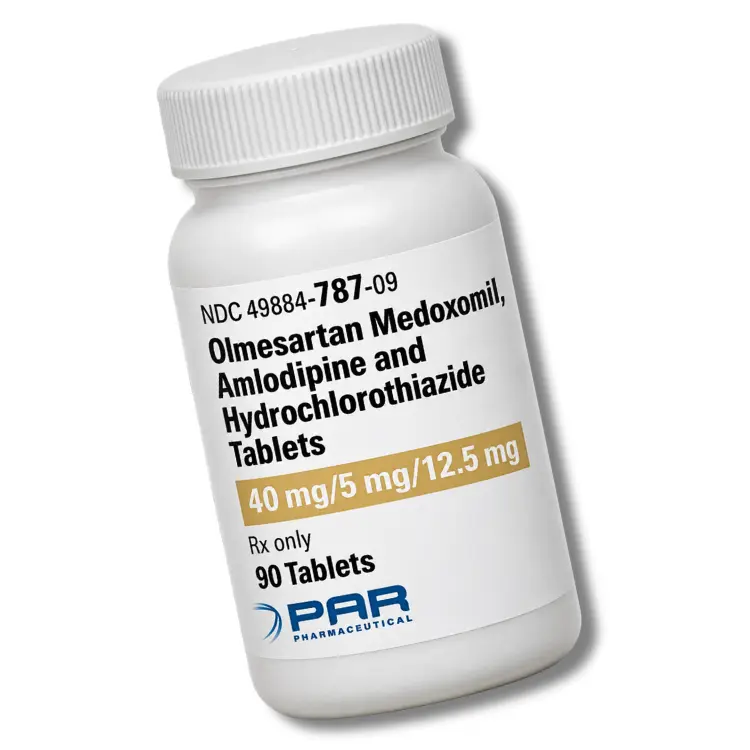
Olmesartan medoxomil + Amlodipine + Hydrochlorothiazide
Single once-daily pill holding three classes of pressure-lowering drug: an ARB, a calcium channel blocker and a thiazide. It replaces separate pills for people who already need all three and is the generic of a brand cleared in 2010; the effect of a dose change is complete within about two weeks.
  • ActiveIngredient: Olmesartan medoxomil + Amlodipine + Hydrochlorothiazide
  • DosageForm: Tablet
  • Dosage: 20/5/12.5 mg to 40/10/25 mg (5 strengths)
  • Indications: Hypertension
  • Manufacturer: Multiple ANDA holders
  • Storage: 20–25°C (68–77°F)
  • Drug Status: Prescription Only

What is Olmesartan-Amlodipine-HCTZ?

Olmesartan-amlodipine-HCTZ is a three-drug tablet for hypertension that combines the ARB olmesartan, the calcium channel blocker amlodipine and the thiazide diuretic hydrochlorothiazide. It is the generic of Tribenzor. It is not indicated as initial therapy. It is used when blood pressure is not controlled on two of these drugs, or by people already taking all three as separate tablets.1

FDA-approved, prescription only
Tribenzor was approved in July 2010; generic versions are also FDA-approved.2

Approved products and generic therapeutic-equivalence ratings are listed in the FDA Orange Book.3

Each ingredient lowers blood pressure by a different route. Olmesartan blocks the receptor for angiotensin II, amlodipine relaxes the muscle in artery walls by blocking calcium entry, and hydrochlorothiazide (HCTZ) increases the loss of salt and water through the kidneys.1

Because the three act on separate mechanisms, adding the third drug to a high-dose pair lowered blood pressure further in the pivotal trial, whichever drug was the one added.

The tablet comes in five strength combinations, so the dose of each component can be matched to what the person was already taking; the strengths differ by olmesartan dose, amlodipine dose and HCTZ dose.

Each component brings its own label warnings: the olmesartan enteropathy and fetal toxicity, amlodipine’s possible worsening of angina when it is started, and HCTZ effects on electrolytes, eyes and skin.

Two-drug versions are covered separately on the Azor and olmesartan-HCTZ pages, and the single ingredient on the olmesartan medoxomil page; all are among the blood pressure medicines.

How to Take Olmesartan-Amlodipine-HCTZ

One tablet once a day

The tablet is taken once daily at about the same time; if blood pressure stays above target, the dose is increased at two-week intervals up to the highest strength.1

Food does not matter

Food does not change how the tablet is absorbed, so it can be taken with or without a meal.

Full effect within two weeks

The full blood pressure effect of a dose change is reached within about two weeks, which is why changes are not made more often.

Keep up your fluids

Drinking too little, heavy sweating, diarrhoea or vomiting can make blood pressure fall too far; if you faint, stop the tablet until you have spoken to the prescriber.

Protect your skin

Because of the HCTZ component, use sun protection and attend regular skin checks.

Keep taking it as prescribed

Continue the tablet even when you feel well, and agree any change or switch back to separate tablets with the prescriber.

What Are the Side Effects of Olmesartan-Amlodipine-HCTZ?

In the pivotal trial, swelling of the ankles and feet, headache and fatigue were the most frequent reactions with the triple tablet; dizziness was more common in people who switched to it than in those who stayed on two drugs.

Triple Tablet: Reactions ≥2%
FrequencyEffectNotes
Common — 7.7%Peripheral oedema (ankle/foot swelling)Olmesartan/HCTZ pair 1.0%
Common — 6.4%HeadachePairs 6.0–7.0%
Common — 5.8–8.9%Dizziness after switching to three drugs1.4–3.6% on pairs
Common — 4.2%FatiguePairs 5.3–6.5%
Common — 3.0–3.5%Nasopharyngitis, nausea, muscle spasmsSimilar on pairs
Uncommon — 1%Fainting (syncope)0.5% or less on pairs
Frequency not established (postmarketing report)Sprue-like enteropathy; low potassium or sodium; acute glaucoma; lupus flare; non-melanoma skin cancer; jaundice with amlodipineRare

Source: 1

Seek immediate medical attention if:
  • Chest pain or angina that is new or worse
  • Sudden eye pain or blurred vision
  • Fainting
  • Severe, persistent diarrhoea with weight loss
Clinical details

In the trial, 4% of people on the triple tablet stopped because of side effects, compared with 1–2% on the two-drug combinations; dizziness, at 1%, was the most common reason.

What is Olmesartan-Amlodipine-HCTZ Used For?

The tablet is indicated for hypertension, alone or together with other blood pressure medicines, but not as the first treatment. Dose selection is based on the treatment the person was already receiving.1

The pivotal trial

The trial enrolled 2,492 people with a mean starting blood pressure of 169/101 mmHg. After two to four weeks on one of three high-dose two-drug combinations, patients either continued that pair or switched to the full three-drug tablet; after eight weeks the triple combination lowered systolic and diastolic pressure more than each pair. Of the participants, 53% were men, 19% were 65 or older, 30% were Black and 15% had diabetes.

What the third drug adds

Adding HCTZ to olmesartan plus amlodipine gave a further 8.4/4.5 mmHg; adding amlodipine to olmesartan plus HCTZ, 7.6/5.4 mmHg; adding olmesartan to amlodipine plus HCTZ, 8.1/5.4 mmHg. The extra lowering held across the 24 hours on ambulatory monitoring.

Groups compared

Reductions did not differ noticeably between Black and non-Black patients or between people with and without diabetes. Only the top strength was tested in the trial; the lower strengths have not been studied for their effect. In the trial, 123 patients were 65 or older and 18 were 75 or older, with no overall differences in efficacy or safety.

Interactions Alcohol:

Use with caution
For the HCTZ component, the labelling notes that alcohol can potentiate orthostatic hypotension.

Interactions Other Medications:

Unsafe
Aliskiren is contraindicated with this tablet in diabetes; other interactions are listed in Interactions.

Special Groups Pregnancy:

Unsafe
Can cause fetal injury and death in later pregnancy; stop as soon as pregnancy is detected.

Special Groups Breastfeeding:

Unsafe
The labelling advises against breastfeeding during treatment.

Special Groups Elderly:

Use with caution
No overall differences were seen in 123 trial patients aged 65 or older, but the 2.5 mg amlodipine start advised from age 75 is not available in this tablet.

Special Groups Children:

Unsafe
Safety and effectiveness in children have not been established.

Effects on Activities Driving:

Use with caution
Dizziness and occasional fainting were more common after switching to the triple tablet; check your reaction before driving.

Effects on Activities Operating Machinery:

Use with caution
Avoid hazardous machinery while dizzy or light-headed.

More dizziness after the switch

In the pivotal trial, dizziness affected 5.8–8.9% of people who moved to the three-drug tablet, against 1.4–3.6% of those who stayed on two drugs, and fainting was reported by 1% compared with 0.5% or less.1

Only the top strength was tested

The blood-pressure-lowering effect of the four lower strengths has not been studied; their use rests on the known effects of the individual components.

Older adults and liver disease

The usual starting dose of amlodipine for people aged 75 or older, or with severe liver impairment, is 2.5 mg, which this tablet does not contain, so this tablet cannot provide that starting dose.

Generic or brand

FDA-approved generic versions must contain the same ingredients and strengths as Tribenzor and be bioequivalent to it.4

Where the tablets come from

This is a prescription-only medicine in the US. The FDA’s BeSafeRx guidance lists four signs of a lawful pharmacy website, including a required prescription and a licensed pharmacist.5

Critical Warnings for Olmesartan-Amlodipine-HCTZ Use

Contraindications

Not for people who pass no urine (anuria), those allergic to any component or to other sulfonamide-derived drugs, or use with aliskiren in people with diabetes.1

Pregnancy

Olmesartan can cause fetal injury and death in the second and third trimesters, and thiazides can cause newborn jaundice and low platelets; stop as soon as pregnancy is detected.

Low blood pressure

Treatment starts under close supervision in people short of salt or fluid; amlodipine can also lower pressure noticeably in severe aortic stenosis.

Angina or heart attack on starting

People with severe obstructive coronary artery disease may have more frequent or severe angina, or a heart attack, when amlodipine is started or its dose is increased.

Kidney function and potassium

Kidney function and potassium can change, particularly with renal artery stenosis, chronic kidney disease or severe heart failure; avoid use when creatinine clearance is 30 mL/min or less.

Electrolytes and metabolism

HCTZ can lower potassium, sodium and magnesium, raise calcium and uric acid, and alter glucose and lipids.

Eyes, lupus, skin

HCTZ can cause sudden short-sightedness and acute angle-closure glaucoma, can activate lupus, and is associated with non-melanoma skin cancer.

Sprue-like enteropathy

Severe chronic diarrhoea with weight loss can appear months to years after starting olmesartan; the tablet is stopped if no other cause is found.6

See Interactions for the full list of drug combinations.

Dosage

Triple Tablet Strengths and Doses
FormulationActive IngredientsClinical Note
Tablet strengths (olmesartan/amlodipine/HCTZ)Three-drug tablet20/5/12.5, 40/5/12.5, 40/5/25, 40/10/12.5, 40/10/25 mg
DoseThree-drug tabletOnce daily; chosen from previous therapy
TitrationThree-drug tabletIncrease after 2 weeks; maximum 40/10/25 mg
Kidney: creatinine clearance ≤30 mL/minThree-drug tabletAvoid use
Liver: severe impairmentThree-drug tabletNot studied; amlodipine and olmesartan exposure rise; 2.5 mg amlodipine start not available
Age 75 and overThree-drug tabletThe 2.5 mg amlodipine starting dose is not available in this tablet

Source: 1

Exceeding the dose
There is no information on overdose with the triple tablet in humans. Olmesartan overdose would be expected to cause low blood pressure and a fast or slow pulse; amlodipine overdose may cause marked widening of blood vessels and reflex tachycardia; HCTZ overdose causes dehydration and electrolyte loss. Care is supportive.1

Marketed strengths and their labelers are listed in the FDA National Drug Code Directory.7

What Does Olmesartan-Amlodipine-HCTZ Interact With?

Interactions by Severity
Interacting SubstanceEffect and RiskSeverityDocumentation
Aliskiren in diabetesHypotension, high potassium, kidney failureContraindicatedExcellent — labelled
ACE inhibitors, other ARBsDual RAS blockade, no added benefitMajorExcellent — labelled
SimvastatinHigher simvastatin exposure; limit simvastatin to 20 mg a dayMajorGood — labelled
Cyclosporine, tacrolimusHigher immunosuppressant levelsMajorGood — labelled
Strong or moderate CYP3A inhibitorsHigher amlodipine exposureModerateGood — labelled
LithiumLithium toxicityMajorGood — labelled
NSAIDsKidney damage; weaker BP and diuretic effectModerateGood — labelled
Colesevelam; cholestyramine, colestipolLess olmesartan (colesevelam) or HCTZ absorbedModerateGood — labelled

Source: 1

For people who need all three, one tablet once a day replaces several pills; it is not used as a first treatment.
Yes. Generic versions contain the same three ingredients in the same strengths and must be bioequivalent to Tribenzor.
Yes. Ankle and foot swelling, from the amlodipine, affected 7.7% of people on the top strength in the trial.
Stop the tablet and contact the prescriber before taking it again.
No. Breastfeeding is not advised during treatment.

Evidence scope

What we know
  • Adding the third drug lowered blood pressure by a further 7.6/5.4 to 8.4/4.5 mmHg.
  • The full effect of a dose change is reached within two weeks.
  • The tablet is not for initial treatment of high blood pressure.
  • Generic versions are FDA-approved.
What remains uncertain
  • Whether it reduces heart attacks or strokes; no outcome trial exists.
  • How well the four lower strengths work; they were not tested.
  • Safety in children.

Source: 1

What has been reported to the FDA

Reports to the FDA naming olmesartan are summarised on the olmesartan medoxomil page.8

Who was this medicine studied in?

The pivotal trial randomised 2,492 adults with a mean blood pressure of 169/101 mmHg; safety data cover 574 people treated with the top strength for eight weeks.1

Who this is and is not appropriate for

Not for initial therapy, anuria, pregnancy, breastfeeding, sulfonamide allergy, or use with aliskiren in diabetes.

Adults whose blood pressure remains high on two of the three components, or who already take all three separately.

Where to report and verify

Routing to Official Registries
What you needWhere to go
Report a side effectFDA MedWatch
Pregnancy-specific dataMotherToBaby
Full prescribing informationDailyMed
Verify a pharmacy websiteFDA BeSafeRx · LegitScript

References

  1. FDA Prescribing Information, TRIBENZOR (olmesartan medoxomil, amlodipine, hydrochlorothiazide) tablets (Cosette Pharmaceuticals; NDA 200175) — Sections 1–8, 10, 12, 14, 17
    Revised 2023-07 · Accessed 2026-10-21
    Used for: limitations of use, strengths, dosing, contraindications, warnings, trial results and adverse reactions, interactions, specific populations.
    dailymed.nlm.nih.gov — TRIBENZOR SPL
  2. Drugs@FDA
    Record accessed 2026-10-21
    Used for: application and marketing status.
    accessdata.fda.gov — Drugs@FDA
  3. FDA Orange Book
    Accessed 2026-10-21
    Used for: reference and generic listings.
    accessdata.fda.gov — Orange Book
  4. FDA — Generic Drugs: Questions & Answers
    Accessed 2026-10-21
    Used for: requirements for generic equivalence (same active ingredient, strength, bioequivalence).
    fda.gov — Generic Drugs Q&A
  5. FDA BeSafeRx — signs of a safe pharmacy website (flyer)
    Accessed 2026-10-21
    Used for: four signs of a lawful pharmacy website.
    fda.gov — BeSafeRx
  6. FDA Drug Safety Communication: FDA approves label changes to include intestinal problems (sprue-like enteropathy) linked to blood pressure medicine olmesartan medoxomil
    Published 2013-07-03 · Accessed 2026-10-21
    Used for: sprue-like enteropathy: onset, recovery on stopping, specificity to olmesartan.
    fda.gov — Drug Safety Communication
  7. FDA National Drug Code Directory
    Directory accessed 2026-10-21
    Used for: marketed products and strengths.
    accessdata.fda.gov — NDC Directory
  8. FDA Adverse Event Reporting System (openFDA)
    Data cut 2026-07-30 · Accessed 2026-10-21
    Used for: report totals and the ten most frequent terms.
    open.fda.gov — drug adverse event API

How this page was sourced

Clinical, dosing and safety facts come from the FDA prescribing information for Tribenzor.

Approval and generic data come from Drugs@FDA; the enteropathy history from the 2013 FDA Drug Safety Communication.

Disclaimer: The information on this site is provided for informational purposes only and is not medical advice. It does not replace professional medical consultation, diagnosis, or treatment. Do not self-medicate based on the information presented on this site. Always consult with a doctor or other qualified healthcare professional before making any decisions about your health.