
People with stage III colon cancer whose tumors are mismatch repair-deficient (dMMR) now have an immunotherapy option after surgery. The FDA has approved atezolizumab (Tecentriq), and its under-the-skin formulation Tecentriq Hybreza, in combination with a fluoropyrimidine and oxaliplatin as adjuvant treatment for stage III dMMR colon cancer. Roche announced the decision on October 9, 2026, and describes it as the first immunotherapy-based regimen approved for this setting (Roche).
Adjuvant therapy is given after a tumor has been surgically removed, to lower the chance that the cancer comes back. Until now, the standard after surgery for stage III colon cancer was chemotherapy built on a fluoropyrimidine, such as fluorouracil or capecitabine, plus oxaliplatin, regardless of a tumor’s mismatch repair status.
Who it is for
People with stage III dMMR colon cancer, after surgery
Cancer-free at 3 years
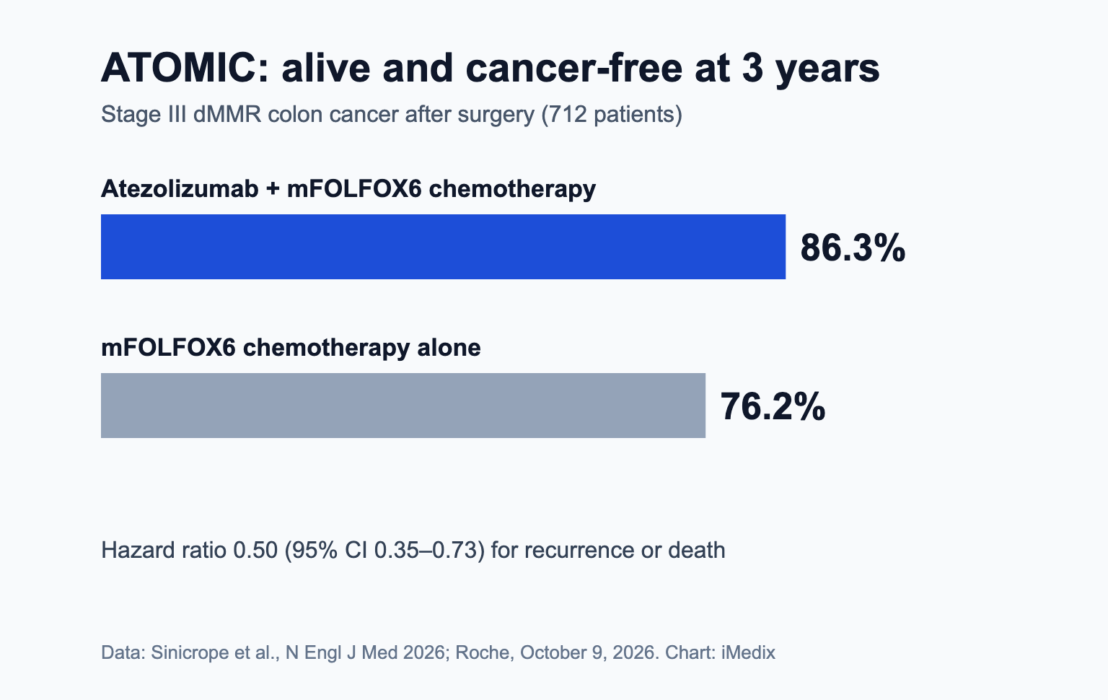
86.3% with atezolizumab vs. 76.2% with chemotherapy alone
Risk reduction
50% lower risk of recurrence or death (HR 0.50)
Severe side effects
Grade 3–4 events in 84.1% vs. 71.9%
Source: ATOMIC trial, New England Journal of Medicine, 2026; Roche, October 9, 2026.
Who qualifies
Mismatch repair is a system cells use to fix errors when DNA is copied. When it fails, tumors build up many mutations, which can make them more visible to the immune system and more likely to respond to immunotherapy. Roche estimates that about 15% of colon cancers are dMMR or microsatellite instability-high (MSI-H). Eligibility is determined by testing the tumor, for example with an immunohistochemistry panel (Roche).
What the ATOMIC trial found
The approval is based on ATOMIC, a phase 3 trial sponsored by the U.S. National Cancer Institute and led by the Alliance for Clinical Trials in Oncology (NCT02912559). It randomly assigned 712 patients with surgically removed stage III dMMR colon cancer to atezolizumab plus mFOLFOX6 chemotherapy (355 patients) or mFOLFOX6 alone (357 patients). In the atezolizumab group, the drug was given with 12 cycles of chemotherapy over six months and then on its own for about six more months. The median age was 64, and more than half of patients had high-risk tumors.
After a median follow-up of 40.9 months, 86.3% of patients in the atezolizumab group were alive and free of cancer at three years, compared with 76.2% in the chemotherapy-only group. The hazard ratio for recurrence or death was 0.50 (95% CI, 0.35–0.73), meaning the risk was cut in half (New England Journal of Medicine).
How strong is the evidence
ATOMIC is a large randomized phase 3 trial, which is strong evidence that adding atezolizumab lowers the chance of the cancer returning. Two cautions apply. The trial was open-label, so patients and doctors knew which treatment was given. And it has not yet shown that people live longer: at five years, 89.7% of patients in the atezolizumab group and 87.9% in the chemotherapy group were alive (hazard ratio 0.90), with 31 and 33 deaths respectively, too few to show a clear difference so far (trial report). The results apply only to dMMR tumors, not to the majority of colon cancers that are mismatch repair-proficient.
Side effects
Adding immunotherapy increased side effects. Severe (grade 3 or 4) adverse events of any cause occurred in 84.1% of patients who received atezolizumab with chemotherapy and in 71.9% of those who received chemotherapy alone; events judged to be treatment-related were reported in 72.5% and 61.7%, respectively (trial report). Roche says the safety profile was consistent with what was already known for atezolizumab and mFOLFOX6.
What this means for patients
For people newly treated for stage III colon cancer, the approval makes the tumor’s mismatch repair status matter for the choice of therapy after surgery. The American Gastroenterological Association notes that the trial reinforces the case for testing every colon cancer for mismatch repair status, which can also flag Lynch syndrome, an inherited condition (American Gastroenterological Association). Patients with dMMR tumors can ask their oncologist whether adding atezolizumab is appropriate, weighing a lower risk of recurrence against more side effects and a longer course of treatment.
The takeaway
The FDA has approved atezolizumab (Tecentriq) with chemotherapy after surgery for stage III dMMR colon cancer. In the ATOMIC trial it raised three-year cancer-free survival from 76.2% to 86.3% and halved the risk of recurrence or death, at the cost of more severe side effects. A survival benefit has not been shown yet, and the approval covers only tumors tested as dMMR.
Sources
- Roche. FDA approves Roche’s Tecentriq in combination with a fluoropyrimidine and oxaliplatin for the adjuvant treatment of a certain type of stage III colon cancer. October 9, 2026.
- Sinicrope FA, et al. Atezolizumab plus FOLFOX for stage III mismatch repair-deficient colon cancer. N Engl J Med. 2026;394:1155-1166.
- Sinicrope FA, et al. Atezolizumab plus FOLFOX for stage III mismatch repair deficient colon cancer. Author manuscript, PubMed Central.
- ClinicalTrials.gov. NCT02912559 (ATOMIC, Alliance A021502).
- American Gastroenterological Association. Atezolizumab boosts colon cancer disease-free survival, study finds. March 2026.
