

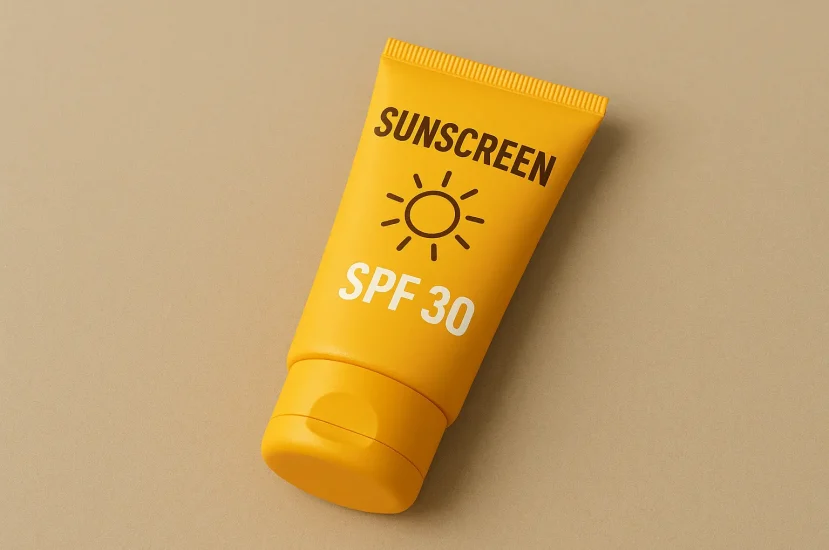
Key Facts
- Think of sunscreen as a non-negotiable part of your daily routine, just like brushing your teeth. Yes, every day.
- Look for these three magic words on the bottle: Broad Spectrum, SPF 30 or higher, and Water Resistant. That’s the trifecta.
- You are almost certainly not using enough. The teaspoon per body part rule is a good guide. Be generous!
- Your makeup with SPF is not a substitute for real sunscreen. It’s a nice bonus, but it’s not the main event.
- Clouds are sneaky. Up to 80% of UV rays can punch right through them. A cool, cloudy day can still be a high-burn day.
On this page:
The Excuses I’ve Heard (and Probably Used)
It’s cloudy. I’m just running to the store. I have a base tan. I hate how it feels. Sound familiar? As a mother who has tried to apply sunscreen to a wriggling toddler, I am deeply familiar with every excuse in the book. But as a health professional, I also know the unfiltered truth: sun damage is real, it’s cumulative, and it’s largely preventable. Skin cancer is one of the most common cancers in the world. And our best, simplest tool against it is that bottle of sunscreen we’re so reluctant to use properly.
So let’s ditch the excuses and have a simple, practical chat about how to do this right. It’s not as complicated as you think.
Decoding the Bottle: What SPF and Broad Spectrum Really Mean
The sunscreen aisle can be an overwhelming wall of numbers and claims. Let’s simplify it. You only need to look for two main things.
SPF (Sun Protection Factor)
This is a number that tells you how much protection you’re getting from UVB rays—the ones that cause sunburn. A higher number means more protection. I tell every family I work with that SPF 30 is your minimum. SPF 50 is even better. Anything less than 30 is, in my opinion, not worth your time or money.
Broad Spectrum
This is just as important as the SPF number, and it’s the part people often miss. The sun’s rays come in different flavors. UVB rays cause the burn, but UVA rays are the silent assassins. They’re the ones that go deeper, causing premature aging (wrinkles, sun spots) and contributing to skin cancer. Broad Spectrum means the sunscreen protects you from both UVA and UVB rays. If it doesn’t say Broad Spectrum on the bottle, put it back on the shelf.
The Biggest Mistake We All Make
Okay, you bought a great, broad-spectrum, SPF 50 sunscreen. Fantastic. Now, here’s where we all fail: we don’t use nearly enough of it. We put a delicate little dab on our nose and a quick smear on our arms and think we’re covered. To get the actual SPF protection that’s written on the bottle, you need to apply it generously.
The official guideline is about one ounce (think a full shot glass) to cover your whole body. A simpler way I remember it is the teaspoon rule:
- 1 teaspoon for your face and neck
- 1 teaspoon for each arm
- 1 teaspoon for each leg
- 1 teaspoon for your front
- 1 teaspoon for your back
It feels like a lot. That’s because it is a lot. But that’s the amount that works. And you have to reapply it every two hours, or more often if you’ve been swimming or sweating.
A Quick, Honest Word on Spray Sunscreens
I know, I know. They’re so convenient, especially with kids. But I need you to be very careful with them. It is incredibly difficult to get an even, thick-enough coating with a spray. The wind blows half of it away, and you miss spots. If you’re going to use a spray, my rule is this: spray it on so heavily that your skin looks wet, and then—this is the important part—rub it in with your hands just like a lotion. This is the only way to ensure you’re actually getting coverage.
It’s Not a Task, It’s a Habit
The only way this works is if it becomes an automatic part of your routine. Put the sunscreen bottle right next to the toothbrushes. In the morning, you brush your teeth, you put on sunscreen. Every single day. Even on cloudy days. Even in the winter.
This isn’t about vanity or avoiding a tan. This is a fundamental health practice, as important as buckling a seatbelt. You’re not just preventing a burn today; you’re protecting your family’s health for a lifetime.