

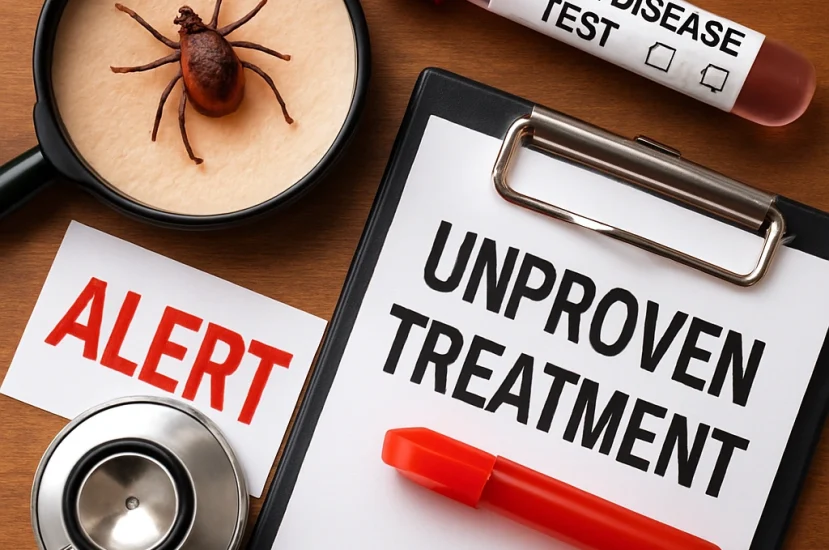
The fever breaks, but the fatigue settles in like a permanent fog. The joints ache, the mind feels clouded, and the classic bull’s-eye rash—the one textbook sign of Lyme disease—never appeared. For a growing number of people, this is the bewildering reality of a post-Lyme existence, a medical gray zone where conventional medicine often runs out of answers. And into this void has stepped a thriving, predatory industry built on questionable science, false hope, and staggering costs.
It’s an ecosystem of misinformation that targets the vulnerable, offering easy answers to a complex illness. But physicians on the front lines are sounding the alarm, warning that many of these alternative paths lead not to healing, but to financial ruin and, in some cases, serious physical harm.
“It really is a buyer-beware situation,” warns Dr. Robert Smith, a leading Lyme specialist at the MaineHealth Institute for Research.
The Diagnostic Dilemma
Part of what makes patients so vulnerable is the inherent slipperiness of diagnosing Lyme disease. In a perfect world, a patient presents with the tell-tale rash, fever, and fatigue. A short, straightforward course of antibiotics usually clears the infection. But medicine is rarely perfect. Many patients never develop the rash, and for a small but significant group, debilitating symptoms persist long after the bacteria should be gone.
The only tool officially recognized for diagnosis is an FDA-approved antibody blood test, but it is a blunt instrument. It can take weeks for the body to produce enough antibodies to register a positive result, leaving a crucial early window of uncertainty. Worse, the test can remain positive for years, making it nearly impossible to distinguish a long-gone infection from an active one.
“That’s one of the problems,” Smith explains. “We can’t say for sure in the first couple of weeks that it’s Lyme disease or not based on these tests.” This diagnostic ambiguity has become the fertile ground in which the alternative industry has taken root.
A Market for Misinformation
A quick search online reveals a parallel universe of Lyme diagnostics, promoted by so-called “Lyme literate” practitioners and sold directly to consumers. These unapproved saliva kits, urine tests, and other novel methods promise a certainty that the standard blood test cannot deliver.
“Any Lyme test available for sale at a drugstore or website is unapproved,” says Andrea Love, a microbiologist and director of the American Lyme Disease Foundation. “When you see these other tests, it’s very likely they’re not accurate and haven’t done their due diligence, which should make people skeptical.”
Often costing hundreds of dollars and rarely covered by insurance, these tests do more than drain a patient’s bank account. They can send them down a dangerous rabbit hole, delaying or preventing them from seeking evidence-based care for the true cause of their symptoms.
The High Cost of False Hope
Once ensnared by questionable testing, patients are often steered toward a bewildering menu of expensive and unproven treatments. A recent review uncovered nearly 120 clinics across the country offering everything from electrical stimulation and ozone infusions to sessions in hyperbaric oxygen chambers. The price tags are breathtaking, ranging from several hundred to over $6,000 for a single treatment, all paid out-of-pocket.
Most alarming to mainstream medical experts is the widespread use of long-term intravenous antibiotic therapy. While a short course of antibiotics is the standard of care for an acute infection, major clinical trials have definitively shown that prolonged use offers no benefit for persistent, post-Lyme symptoms. What it does offer is a host of severe risks, including the destruction of beneficial gut bacteria, which can lead to life-threatening intestinal infections.
“There is clearly harm being done to people who are suffering,” says Smith, his frustration palpable. “Out of desperation, they take on these great expenses or can be harmed by treatments that are not proven effective.”
The scientific community is not ignoring their pain. A recent consensus report from the National Academies of Sciences, Engineering, and Medicine called for an urgent increase in research to understand and treat the long-term, debilitating symptoms that some patients experience.
“The key thing is that these people are suffering,” Smith emphasizes, “and we need to come up with strategies to alleviate that suffering, whatever the trigger was.”
Until then, the advice from experts is unequivocal: trust the established science, seek out qualified infectious disease specialists, and view any provider promising a quick, alternative cure with extreme caution. For those lost in the fog of a chronic illness, the challenge is separating a lifeline from a lure.
